Starting a US Company From Abroad: What Foreign Founders Need to Know About US Tax Obligations

Why So Many Founders Choose a US Company
Imagine you live in Berlin, Lagos, Manila, or Manchester. You have built a software product, a consulting practice, or an online shop. Your customers are all over the world, and many of them are in the United States. You have never set foot in America, and you do not plan to move there. Yet you keep hearing the same advice: "Set up a US company."
There are good reasons for this. A US limited liability company (LLC) or corporation can give you access to American payment processors such as Stripe and PayPal, US business bank accounts, credibility with American clients, and a clear legal structure for taking on investors. For founders in countries with unstable banking or currency rules, a US company can feel like a safe harbour.
But here is the part that trips people up: owning a US company comes with US rules. Many of those rules are about tax and reporting. The good news is that if you live and work outside the United States, you may owe little or no US income tax. The dangerous news is that even when you owe zero tax, you can still face large penalties for failing to file the right forms. These two things are not the same, and confusing them is the single biggest mistake foreign founders make.
Let us walk through this in plain language.
First Decision: LLC or Corporation?
The two most common choices for foreign founders are the LLC and the C corporation. They are treated very differently by the US tax authorities.
The LLC
An LLC is flexible. By default, an LLC with one owner is treated as a "disregarded entity." That is a fancy phrase that simply means the US tax system looks straight through the company to the owner. The company itself is usually not taxed. Instead, the income is treated as belonging to you.
This can be a great result for a foreign founder, but only if your income is not connected to a US trade or business (more on that crucial point below).
The C Corporation
A C corporation is treated as a separate taxpayer. It pays US corporate income tax on its profits at a flat federal rate of 21% under the Internal Revenue Code (IRC § 11). When it later pays profits to you as a dividend, there may be a second layer of tax. Investors, especially US venture capital funds, often prefer corporations because the structure is familiar to them.
There is no single "best" choice. It depends on your goals, your customers, where you live, and whether you plan to raise money. This is exactly the kind of decision where guidance pays for itself.
The Big Question: Are You Earning "US-Source" Income?
This is the heart of everything. The United States generally taxes foreign people (called "non-resident aliens" in the law) on two things:
- Income from US sources, and
- Income that is effectively connected with a US trade or business (often shortened to "ECI").
The rules for working out the source of your income are set out in the Internal Revenue Code (IRC §§ 861–865) and explained in IRS Publication 519, the US Tax Guide for Aliens.
Here is the rule that matters most to remote founders. For income from personal services — which includes consulting, freelancing, software development, and most online service work — the source of the income is the place where the work is physically done.
So, if you are sitting in your flat in Dublin or Nairobi doing the work, that income is generally foreign-source income, even if your client is American and even if you are paid through your US LLC into a US bank account. As Publication 519 explains, "All wages and any other compensation for services performed in the United States are considered to be from sources in the United States" — the key words being performed in the United States.
If you never perform the work inside the United States, you usually have no US-source service income.
What "effectively connected" really means
You become much more exposed to US tax if you are "engaged in a trade or business in the United States." Generally, this happens when you, your employees, or your dependent agents carry out regular, continuous business activity inside US borders.
Working from your own country, selling to American customers over the internet, does not by itself make you "engaged in a trade or business in the United States." But things change if, for example, you:
- Rent an office or warehouse in the US,
- Hire staff who work inside the US on your behalf,
- Spend significant time physically in the US running the business, or
- Use a US-based agent who has the power to close deals for you.
These are grey areas, and the answer depends on your exact facts. Getting this wrong in either direction is costly — either you pay tax you did not owe, or you fail to pay tax you did owe.
The Trap That Catches Almost Everyone: Form 5472 and Form 1120
Now we come to the rule that has cost foreign founders the most money in penalties — not because of tax owed, but because of paperwork missed.
If a foreign person owns at least 25% of a US LLC that is treated as a disregarded entity, the IRS treats that LLC as if it were a corporation for one narrow purpose: information reporting under IRC § 6038A.
In plain terms: even though your single-member LLC normally "disappears" for tax purposes, you must still file a special report every year if there were any "reportable transactions" between you and your company. And almost everything counts as a reportable transaction — money you put into the company, money you took out, loans, contributions, and so on.
You do this by filing:
- A pro forma Form 1120 (a mostly blank corporate return used only as a cover sheet), with
- Form 5472 (Information Return of a 25% Foreign-Owned US Corporation) attached.
Publication 519 confirms this directly: a foreign-owned domestic disregarded entity "must file a pro forma Form 1120 with Form 5472 attached by the due date (including extensions) of the return."
Here is why founders panic when they learn this late: the penalty for failing to file Form 5472 on time is US$25,000 per form, per year. This penalty applies even if your company made no profit, owed no tax, and had only a few simple transactions. Many founders set up an LLC, do no tax filing because "the business made no money," and then discover years later that they owe tens of thousands in penalties.
To file these forms, your LLC needs an Employer Identification Number (EIN) from the IRS. You can obtain an EIN even without a US Social Security Number.
C corporations have their own filing duty: they file a full Form 1120 every year and, if they make certain payments to foreign owners, may also need Form 5472.
Withholding Tax: The 30% You Might Not Expect
The United States protects its tax base with withholding. Under IRC §§ 1441 and 1442, US payers must generally withhold 30% of certain US-source payments to foreign persons — things like interest, dividends, rents, and royalties (not ordinary service fees performed abroad).
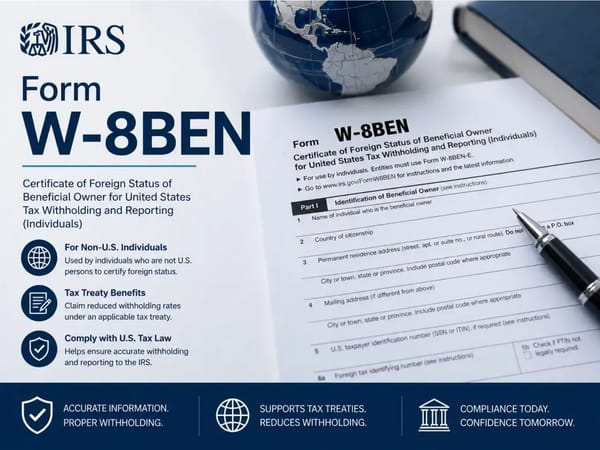
This is where the W-8BEN form comes in. By giving a properly completed Form W-8BEN to the company or platform paying you, you certify that you are a foreign person and, where a tax treaty applies, you may claim a reduced rate. We have written separately about completing the W-8BEN, but the key point here is simple: documentation protects you. Without it, payers may withhold the full 30%, and you would then have to file a US return to claim any of it back.
If your US corporation pays a dividend to you as a foreign shareholder, that dividend is US-source income and is typically subject to the 30% withholding tax — unless an income tax treaty between the US and your country reduces it.
Tax Treaties: Your Country May Have a Deal With the US
The United States has income tax treaties with many — but not all — countries. These treaties can lower withholding rates on dividends, interest, and royalties, and they contain rules (called "permanent establishment" rules) that help decide when business profits can be taxed by the US.
A treaty can be very valuable, but treaties are technical, and a few have been suspended or terminated. For example, Publication 519 notes that the US–Hungary treaty was terminated, and parts of the treaties relating to Russia and Belarus have been suspended in recent years. You cannot assume a treaty still works the way it did five years ago. This is another area where professional guidance is sensible rather than optional.
Hiring Help: Foreign Contractors and US Contractors
Many founders grow by hiring. The tax treatment depends on who you hire and where they work.
- Foreign contractors working abroad. If you hire, say, a designer in Brazil who does all the work in Brazil, that is generally foreign-source income to them, and your US LLC usually has no US withholding duty. You would typically collect a Form W-8BEN from them for your records, rather than reporting them to the IRS on a 1099.
- US contractors working in the US. If you hire an American freelancer, you generally collect a Form W-9 and may need to issue a Form 1099-NEC reporting what you paid them.
Be careful not to accidentally create a US "trade or business" presence by hiring people who work inside the United States on your behalf. The location of your workers matters.
Bank Accounts Abroad: FBAR and FATCA
Here is a point that surprises founders. These rules are usually about you as a person, based on your tax status, not automatically about your foreign-owned US LLC. But they matter if your tax situation changes — for example, if you spend enough time in the US to become a US tax resident, or if you elect to be treated as a US resident.
- The FBAR (FinCEN Form 114) requires US persons to report foreign bank accounts when the total goes above US$10,000 at any point in the year.
- FATCA (Form 8938) requires certain people to report foreign financial assets above set thresholds.
For a founder who remains a non-resident living abroad, these may not apply to the US company structure in the way people fear — but the moment your personal status shifts, the picture changes quickly. Knowing where you stand is part of staying safe.
State Rules Are a Whole Separate Layer
So far, we have talked about federal US taxes. But the US also has states, and each one has its own rules. Founders often form companies in Delaware, Wyoming, or New Mexico because of their business-friendly frameworks. Even then, you may face:
- Annual franchise taxes or report fees (Delaware, for instance, charges an annual franchise tax and requires an annual report),
- Registered agent fees (every US company must have a registered agent with a physical address in the state), and
- Possible filing duties in any state where you create a real business presence.
A common myth is that a "tax-free state" means "no obligations." That is not true. There are still annual filings and fees, and missing them can lead to your company being dissolved or hit with penalties.
A Quick Reality Check: Common Myths
Let us clear up the most damaging misunderstandings.
- "My company made no money, so I do not need to file anything." False. Form 5472 (with pro forma 1120) can be due even with zero profit, and the penalty for missing it is US$25,000.
- "I do not live in the US, so US rules do not apply to me." Partly false. Owning a US company creates US filing duties regardless of where you live.
- "Owing no tax means I am safe." False. Penalties for late or missing forms are separate from tax owed. You can owe nothing and still be fined heavily.
- "A tax-free state means no paperwork." False. State annual reports and registered-agent rules still apply.
Staying compliant is not about paying more tax. In many cases it is about correctly proving that you owe little or none — and filing the right forms on time so the penalties never start.
How Atlas Founders Advisory Ltd. and Remote Business Services LLC Can Help
If your head is spinning, that is completely normal. The structure is not impossible — thousands of foreign founders run compliant US companies from abroad — but it does require someone who understands both sides of the ocean.
That is exactly why Atlas Founders Advisory Ltd. (UK) exists, working hand in hand with its U.S. sister company, Remote Business Services LLC (US). Together, these two firms are built around one mission: helping non-US founders start, run, and remotely operate a US LLC or corporation while staying fully compliant with US federal and state tax laws.
Here is what makes this pairing genuinely useful to you:
- A single team for both worlds. Atlas Founders Advisory (UK) understands how things look from a European and international founder's point of view, while Remote Business Services LLC (US) handles the American filings, EIN applications, Form 5472 and 1120 reporting, withholding documentation (W-8BEN, W-9, 1099 issues), and state-level annual requirements. You do not have to stitch together advisers in two countries who do not talk to each other.
- Led by an IRS Enrolled Agent. The owner of both companies is licensed by the US IRS as an Enrolled Agent — the highest credential the IRS issues, with the authority to represent taxpayers before the IRS in all 50 states. That means your US filings are handled by someone the IRS itself recognises as qualified, not by guesswork from an online forum.
- GDPR-aware from day one. Because so many founders are based in the UK and EU, data protection is taken seriously. The owner is also a Data Controller Associate, experienced and familiar with UK and EU GDPR requirements. Your personal information is treated with the care that European law demands — something many purely US-based providers simply do not understand.
- Built for remote founders. The entire service is designed for people who will never need to set foot in the United States to run their business. Formation, EIN, compliance calendars, annual filings, and ongoing advice are all handled remotely.
If you are thinking about forming a US company — or if you already have one and you are quietly worried that you may have missed a filing — the smartest move is to get clarity before a penalty notice arrives. A short conversation now can save you from a US$25,000 surprise later.
👉 Visit atlasfoundersadvisory.co.uk or remotebizservices.com to arrange a consultation. Let an IRS-licensed Enrolled Agent, who also understands your GDPR rights, guide you through starting and remotely operating your US LLC or corporation with confidence.
Disclaimer: This article is provided for informational and educational purposes only. It does not constitute legal, accounting, or professional tax advice. Every founder's situation is different. Please consult a qualified tax professional about your own circumstances. For your safety, please do not share sensitive details such as Social Security Numbers, EINs, passport numbers, or specific financial figures in any online conversation.