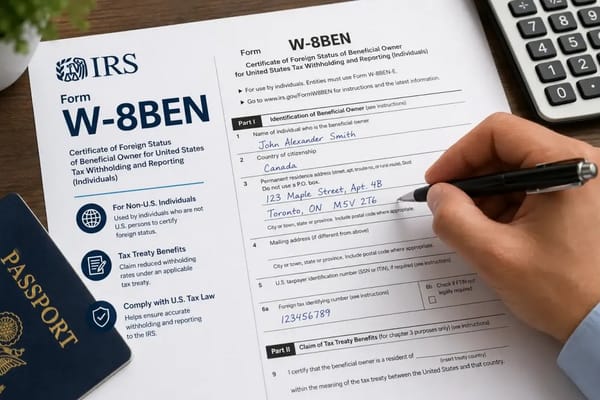
The IRS W-8BEN: What It Is and Why You Must Have Contractors Fill It Out The IRS W-8BEN: What It Is and Why You Must Have Contractors Fill It Out
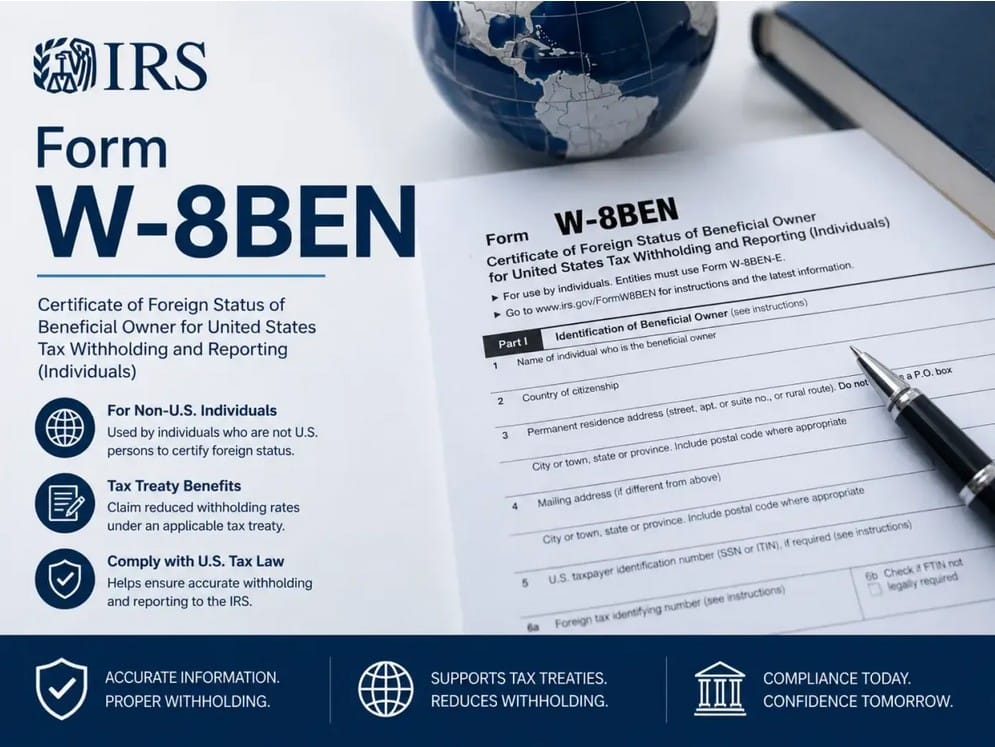
If your business hires freelancers, consultants, virtual assistants, developers, designers, marketers, or other independent contractors from outside the United States, there's one tax document you absolutely need to understand:
IRS Form W-8BEN.
Many business owners discover this form only after they've already started working with international contractors. Others mistakenly assume it's only relevant for large corporations or businesses making significant international payments.
The reality is much simpler—and much more important.
If you're paying foreign individuals for services or other qualifying income, collecting a properly completed W-8BEN can help protect your business from tax compliance issues, unnecessary withholding obligations, and potential IRS penalties.
In this guide, we'll break down what Form W-8BEN is, who needs it, why it's important, and how it helps both businesses and contractors stay compliant with U.S. tax laws.
What Is Form W-8BEN?
Form W-8BEN, officially known as the Certificate of Foreign Status of Beneficial Owner for United States Tax Withholding and Reporting (Individuals), is an IRS document used by foreign individuals to certify that they are not U.S. persons.
In plain English, the form tells a U.S. company:
"I am not a U.S. citizen or resident, and I am claiming foreign status for tax purposes."
The form is completed by the foreign contractor and provided to the U.S. company that is making payments.
Unlike many IRS forms, the W-8BEN is generally not submitted directly to the IRS. Instead, the paying company keeps it on file as documentation supporting its tax treatment of payments made to the contractor.
Why Does the IRS Require It?
The U.S. tax system treats payments made to foreign persons differently than payments made to U.S. persons.
When a U.S. company pays an American contractor, the company generally collects a Form W-9 and may issue a Form 1099 at year-end.
When the contractor is a foreign individual, however, the company needs evidence that the contractor is not a U.S. taxpayer. That's where the W-8BEN comes in.
Without proper documentation, the IRS may presume the recipient is subject to certain withholding and reporting requirements.
The W-8BEN serves as proof that the individual receiving payment is foreign and may qualify for specific tax treatment under U.S. law or applicable tax treaties.
Who Should Complete a W-8BEN?
Generally speaking, a W-8BEN should be completed by:
- Foreign freelancers
- Independent contractors
- Consultants
- Remote workers operating as sole proprietors
- Foreign investors receiving certain U.S.-source income
- Non-U.S. individuals receiving payments from U.S. companies
For example, if your company hires:
- A graphic designer in Canada
- A software developer in India
- A marketing consultant in the United Kingdom
- A virtual assistant in the Philippines
You will likely want a completed W-8BEN on file before making payments.
Who Should NOT Use Form W-8BEN?
Not everyone can use this form.
The W-8BEN is intended for individuals only.
Entities such as corporations, partnerships, and certain foreign businesses generally use different forms, including:
- W-8BEN-E
- W-8ECI
- W-8EXP
- W-8IMY
For example, if you're hiring a foreign corporation rather than an individual freelancer, the company may need to provide a W-8BEN-E instead.
This distinction is important because collecting the wrong form can create compliance issues later.
Why Businesses Must Collect W-8BEN Forms
Many business owners view tax forms as administrative paperwork.
The W-8BEN is much more than that.
It serves as a key compliance document that protects your business.
1. It Documents Foreign Status
The most important function of the form is proving that the contractor is not a U.S. person.
Without documentation, your company may have difficulty demonstrating why it did not treat the contractor as a U.S. taxpayer.
The IRS expects businesses to maintain records supporting their tax reporting decisions.
A completed W-8BEN provides that evidence.
2. It Helps Determine Withholding Requirements
Certain payments to foreign persons may be subject to U.S. withholding tax.
The W-8BEN helps determine:
- Whether withholding applies
- Whether reduced withholding rates apply
- Whether treaty benefits may be available
Without the form, your company may be forced to withhold taxes unnecessarily or expose itself to compliance risk.
3. It Protects Your Business During Audits
If the IRS ever reviews your records, one of the first questions may be:
"How did you determine this recipient was foreign?"
Having a properly completed W-8BEN on file provides a clear answer.
Businesses that fail to maintain adequate documentation can face increased scrutiny and potential penalties.
4. It Supports Proper Tax Reporting
International tax reporting can be complicated.
The W-8BEN helps establish the tax classification of the recipient and supports accurate reporting obligations.
Simply put, it's one of the foundational documents for paying foreign contractors correctly.
What Information Does the Form Require?
The W-8BEN is relatively straightforward.
The contractor typically provides:
Full Legal Name
The name must match the individual's legal identity.
Country of Citizenship
The individual identifies their country of citizenship.
Permanent Residence Address
This should generally be the contractor's foreign residential address.
Foreign Tax Identification Number
In many cases, the contractor provides a tax identification number issued by their home country.
Date of Birth
The IRS requires the individual's date of birth for identification purposes.
Treaty Claim Information (If Applicable)
If the individual wishes to claim benefits under a tax treaty between the United States and their home country, they may complete the treaty section.
Signature and Certification
The contractor signs the form under penalties of perjury, certifying that the information provided is accurate.
What Are Tax Treaty Benefits?
One section of the W-8BEN often causes confusion: treaty benefits.
The United States has income tax treaties with many countries.
These treaties can reduce or eliminate certain U.S. withholding taxes that might otherwise apply.
For example, a contractor from a treaty country may qualify for a reduced withholding rate on specific types of income.
The treaty section allows eligible individuals to claim those benefits.
However, not everyone qualifies, and treaty provisions can be complex.
When contractors are unsure whether they qualify, consulting a qualified tax professional is often the best course of action.
What Happens If You Don't Collect a W-8BEN?
This is where things can become problematic.
Failing to collect a W-8BEN can create several risks for businesses.
Increased Compliance Exposure
Without documentation, your company may not be able to demonstrate why payments were treated as payments to a foreign person.
Potential Withholding Issues
In certain circumstances, the absence of proper documentation may trigger withholding obligations.
Audit Risks
Missing forms often attract attention during audits and compliance reviews.
Administrative Headaches
Trying to obtain forms years after payments were made is significantly harder than collecting them upfront during onboarding.
The easiest solution is simple:
Request the W-8BEN before issuing the first payment.
How Long Is a W-8BEN Valid?
A W-8BEN does not last forever.
Generally, the form remains valid beginning on the date it is signed and ending on the last day of the third succeeding calendar year.
For example:
- Form signed: June 2025
- Valid through: December 31, 2028
After expiration, the contractor should provide an updated form.
Businesses should have processes in place to monitor expiration dates and request renewals when necessary.
W-8BEN vs. W-9: What's the Difference?
One of the most common questions businesses ask is whether they need a W-8BEN or a W-9.
The answer depends entirely on who you're paying.
Form W-9
Used by:
- U.S. citizens
- U.S. residents
- U.S. businesses
Purpose:
- Provides a taxpayer identification number
- Supports 1099 reporting
Form W-8BEN
Used by:
- Foreign individuals
Purpose:
- Certifies foreign status
- Supports international tax compliance
A simple rule of thumb:
U.S. persons generally provide a W-9. Foreign individuals generally provide a W-8BEN.
Best Practices for Businesses Hiring Foreign Contractors
Collecting forms is only one part of the process.
Businesses should develop a consistent compliance workflow.
Request Documentation Early
Don't wait until year-end.
Collect tax forms during onboarding.
Verify Completeness
Review forms to ensure all required sections are completed and signed.
Maintain Secure Records
Store forms securely and retain them according to your document retention policies.
Track Expiration Dates
Implement reminders for renewals before forms expire.
Work With Qualified Advisors
International tax compliance can become complicated quickly, especially as your contractor network grows.
A knowledgeable accountant or tax advisor can help ensure your processes remain compliant.
Common Mistakes Businesses Make
Waiting Too Long
The biggest mistake is waiting until tax season to gather forms.
By then, contractors may be difficult to reach or may no longer work with your company.
Using the Wrong Form
Not every foreign contractor should submit a W-8BEN.
Foreign entities often require a W-8BEN-E instead.
Assuming Foreign Contractors Don't Need Documentation
Some businesses mistakenly believe that because a contractor lives outside the United States, no paperwork is required.
The opposite is true.
International payments generally require even more attention to documentation.
Failing to Renew Expired Forms
Expired forms can create compliance gaps.
Tracking expiration dates is essential.
Creating a Smooth Contractor Onboarding Process
The easiest way to manage W-8BEN compliance is to build it into your onboarding workflow.
A simple process might look like this:
- Contractor signs service agreement.
- Contractor completes tax documentation.
- Business reviews forms.
- Documents are securely stored.
- Payments begin.
- Expiration dates are tracked.
This approach eliminates last-minute scrambling and creates a cleaner audit trail.
Final Thoughts
If your business works with international freelancers, consultants, or contractors, understanding Form W-8BEN is not optional—it's an important part of responsible tax compliance.
The form serves a straightforward but critical purpose: it documents that the person you're paying is a foreign individual and helps determine the appropriate tax treatment of those payments.
For businesses, collecting a properly completed W-8BEN can help reduce compliance risk, support accurate reporting, and provide valuable documentation if questions ever arise.
For contractors, it helps establish foreign status and may allow them to claim available treaty benefits when applicable.
The best practice is simple: make the W-8BEN a standard part of your onboarding process for every eligible foreign contractor. Collect it before making payments, keep it on file, monitor expiration dates, and review your procedures regularly.
A few minutes spent gathering the right paperwork today can save your business significant time, expense, and stress in the future.
Keywords: IRS W-8BEN, W-8BEN form, foreign contractor tax form, international contractor compliance, W-8BEN vs W-9, IRS withholding rules, foreign freelancer tax documentation, U.S. business paying foreign contractors, tax forms for nonresident contractors, W-8BEN requirements
Disclaimer:
The content on this website is for informational and educational purposes only and does not constitute professional legal, tax, or financial advice. You should not act upon any information presented here without first seeking counsel from a qualified professional licensed in your jurisdiction.
We disclaim all liability for actions taken or not taken based on any content found on this site.